Your complete guide to choosing the right modernization strategy — from legacy migration to cloud-native application development and enterprise app modernization, with Flynaut as your strategic partner.
Introduction to Enterprise App Modernization & Digital Transformation
In the age of cloud-native computing, mobile-first business models, and AI-driven transformation, legacy systems can no longer keep up with the speed of innovation. According to IDC, organizations spend nearly 75% of their IT budgets maintaining outdated systems, leaving little room for innovation.
Enterprise app modernization is no longer optional, it’s the foundation of digital competitiveness and long-term enterprise transformation consulting initiatives. Yet, the challenge lies in choosing the right modernization pattern. Should you rehost? Replatform? Refactor?
Each approach comes with its own trade-offs, costs, and strategic implications. This guide unpacks the seven key app modernization patterns, what they mean, when to use them, and how Flynaut, a leading digital transformation agency USA, helps organizations modernize intelligently and cost-effectively.
Understanding Application Modernization Services for Enterprise Transformation
App modernization is the process of transforming existing software, often monolithic, on-premise, and outdated, into modern, agile, and cloud-compatible systems as part of broader digital transformation services USA.
It can involve:
- Moving from legacy infrastructure to cloud environments using cloud infrastructure services USA
- Redesigning applications for scalability and performance, and enterprise app development services
- Integrating automation, APIs, and microservices, and AI integration services
- Reducing technical debt while maintaining business continuity through custom software modernization
The right modernization strategy depends on your current architecture, business objectives, and risk tolerance. The seven patterns below form the spectrum of options, from quick migration to complete reinvention.
The 7 Enterprise App Modernization Patterns Explained
1. Rehost (Lift and Shift) for Legacy Application Modernization
What it is:
Rehosting means moving your application from on-premises infrastructure to the cloud, as is, with minimal code or architecture changes. It is often the first step in legacy application modernization.
When to use it:
- You need a fast, low-risk migration to the cloud.
- You want to reduce infrastructure costs and improve scalability.
- You don’t have the time or budget for deep refactoring.
Advantages:
- Quickest migration approach.
- Minimal disruption to operations.
- Immediate reduction in hardware and IT infrastructure management costs.
Challenges:
- Doesn’t improve code quality or performance.
- Legacy inefficiencies are carried over.
Example:
A financial firm running .NET applications on legacy servers moves them to AWS EC2 instances using Flynaut’s automated rehosting framework, achieving 35% cost savings in six months.
2. Replatform (Lift, Tinker, and Shift) for Cloud Infrastructure Optimization
What it is:
Replatforming involves migrating to the cloud but making light optimizations to improve performance or scalability, like updating middleware, switching databases, or leveraging cloud services.
When to use it:
- You want some performance improvement without full re-architecture.
- Your app already supports containerization or APIs.
Advantages:
- Improves cost efficiency and scalability.
- Enables partial modernization without full code changes.
- Faster than refactoring.
Challenges:
- Still limited in long-term agility.
- Some manual dependency management required.
Example:
A retail enterprise replatforms its eCommerce app to Azure App Service with Flynaut’s DevOps automation, reducing load times by 50% and downtime by 80%.
3. Refactor Applications for Cloud-Native Performance and Automation
What it is:
Refactoring means reworking the existing code to adopt new frameworks or architectures, such as containerization, microservices, or API-driven design, without changing core business logic.
When to use it:
- Your app needs better scalability, maintainability, and cloud compatibility
- You want to improve developer productivity and deployment speed
Advantages:
- Reduces technical debt
- Improves performance and security
- Enables CI/CD and process automation services
Challenges:
- Higher cost and complexity than rehost/replatform
- Requires expert DevOps and digital consulting services
Example:
Flynaut refactors a logistics app into a containerized microservices architecture using Kubernetes and AWS Lambda, cutting deployment times from hours to minutes.
4. Rearchitect Enterprise Applications for Scalable Digital Transformation
What it is:
Rearchitecting involves a fundamental redesign of the application, moving from a monolithic structure to a cloud-native, microservices-based architecture.
When to use it:
- Legacy systems limit business growth and integration
- You need cloud-native scalability, agility, and innovation speed
- You want to integrate advanced capabilities like AI integration services and IoT development services USA
Advantages:
- Long-term agility and performance gains
- Enables modern development practices
- Supports continuous innovation and enterprise digital transformation consulting
Challenges:
- Requires significant investment and skilled teams
- Longer delivery timeline
Example:
A healthcare organization rearchitects its patient management system with Flynaut’s cloud-native framework, achieving real-time interoperability with IoT health devices and AI insights.
5. Rebuild Applications from Scratch for Future-Ready Enterprise Systems
What it is:
Rebuilding involves completely rewriting the application from the ground up while preserving its business logic and functionality.
When to use it:
- Legacy code is unsalvageable
- You need cutting-edge user experience and performance
- You’re targeting new markets, platforms, or business models
Advantages:
- Complete freedom to design for the future
- Eliminates legacy constraints entirely
- Future-proofs your enterprise app modernization strategy
Challenges:
- Time-consuming and resource-intensive
- Requires expert planning and testing
Example:
Flynaut rebuilt a manufacturing ERP system using modern APIs, React UI, and cloud integration, enabling predictive analytics and multi-device access.
6. Replace Legacy Systems with SaaS or COTS Solutions
What it is:
Instead of maintaining or modernizing your legacy system, you replace it with a commercial off-the-shelf (COTS) or Software-as-a-Service (SaaS) solution that meets similar business needs.
When to use it:
- Your legacy app no longer provides competitive advantage
- A proven, cost-effective SaaS solution exists
Advantages:
- Fastest time-to-value.
- Lower maintenance burden.
- Frees internal teams to focus on innovation.
Challenges:
- Loss of customization.
- Potential integration or data migration complexity.
Example:
Flynaut helped a real estate company replace its legacy CRM with a customized Salesforce-based solution integrated with its property management system.
7. Retire and Consolidate Legacy Applications to Reduce IT Complexity
What it is:
Sometimes the smartest modernization strategy is elimination. Retiring means identifying redundant, outdated, or low-value applications and shutting them down.
When to use it:
- Legacy apps duplicate functionality.
- Usage and ROI are minimal.
- You need to simplify IT operations.
Advantages:
- Immediate cost savings.
- Reduces security and compliance risks.
- Simplifies your technology stack.
Challenges:
- Requires careful data migration and archival planning.
- Change management to handle user impact.
Example:
Flynaut helped a financial institution retire 12 legacy internal apps, merging their core functionalities into one cloud-based platform, reducing annual operating costs by 40%.
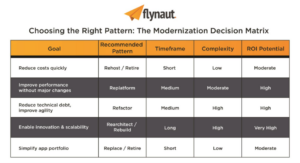
Choosing the Right Enterprise App Modernization Strategy: Decision Matrix
Flynaut’s 5-Step Enterprise App Modernization Framework
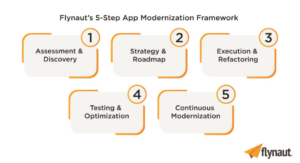
At Flynaut, modernization is not just about technology — it’s about business transformation. We combine engineering expertise, AI-driven insights, and agile delivery to ensure results.
- Assessment & Discovery
We audit your existing systems, dependencies, performance, and business goals using our proprietary AI-powered code analysis tools.
- Strategy & Roadmap
Based on cost, risk, and value analysis, we recommend the optimal modernization pattern or hybrid approach.
- Execution & Refactoring
Using advanced automation and DevOps pipelines, our teams migrate, refactor, or rearchitect your applications securely.
- Testing & Optimization
We employ continuous testing and performance tuning to ensure reliability, compliance, and security.
- Continuous Modernization
Modernization doesn’t stop at launch, Flynaut provides ongoing monitoring, scalability updates, and innovation roadmaps.
Why Choose Flynaut for Enterprise App Modernization Services
- Full-spectrum expertise — From legacy systems to GenAI-driven modernization.
- Proven U.S. leadership — Trusted by enterprises across finance, healthcare, retail, and manufacturing.
- Cloud-native excellence — AWS, Azure, and GCP certified specialists.
- Data security first — Compliance-ready modernization that protects sensitive data.
- ROI-driven approach — Every engagement is measured against cost savings and performance KPIs.
With Flynaut, modernization is not just a technical project, it’s a strategic transformation initiative designed to accelerate business outcomes.
Real Business Results Delivered by Flynaut
- $2.5M annual savings for a logistics firm via replatforming and containerization.
- 45% faster deployment for a healthcare startup through refactoring and CI/CD automation.
- 60% lower maintenance costs for a financial app after retiring outdated modules.
- 3x scalability for an education SaaS through rearchitecture and cloud-native rebuild.
Flynaut’s modernization practice turns legacy systems into competitive assets — faster, safer, and smarter.
Conclusion: Choosing the Right App Modernization Strategy
Modernization is not one-size-fits-all. Each pattern, from Rehost to Rearchitect, plays a distinct role in your digital transformation journey. The key is choosing the right combination based on your goals, timeline, and budget.
Whether you need to migrate legacy workloads, refactor for performance, or rebuild for innovation, Flynaut brings the expertise, technology, and strategy to deliver measurable success.
With the right partner, modernization isn’t just an IT upgrade, it’s a business growth accelerator.
Modernize Smarter with Flynaut
Unlock speed, security, and scalability, without disrupting business.
Partner with Flynaut, the #1 app development and modernization company in the U.S., to rehost, replatform, or rearchitect your legacy systems with confidence.