Technical Debt Modernization: A CFO Framework for Smarter IT Investment
The burden of legacy systems and accumulated technical debt is becoming a strategic inhibitor rather than just an engineering concern. For CFOs navigating technical debt modernization, the challenge is balancing cost control, risk reduction, and long-term digital modernization without disrupting core operations.
This playbook gives you a clear framework for decision-making, real business metrics and the role of a partner like Flynaut in executing the plan.
Why Technical Debt Impacts CFO Strategy, Risk, and Total Cost of Ownership
- The term “technical debt” refers to the shortcuts, deferred maintenance, legacy systems, legacy architectures and outdated infrastructure that build up interest over time, increasing maintenance costs, decreasing agility and opening risk.
- According to McKinsey & Company, companies that don’t actively manage technical debt have significantly reduced ability to modernize.
- In large enterprises, outdated technology and legacy systems can cost hundreds of millions of dollars annually in lost opportunity, inefficiency, risk and cancelled projects.
- For a CFO, tech-debt impacts not only IT budgets but also balance-sheet risk (obsolete assets), amortisation of technology investments, M&A readiness, and ability to launch new digital revenue streams.This is why many CFOs now prioritize IT modernization strategy and application modernization strategy as part of long-term financial planning.
Cloud Migration vs Modernization: Choosing the Right IT Modernization Strategy
When you face a high debt burden and legacy systems, there are two broad strategic pathways. This decision-often framed as cloud migration vs modernization-has direct implications for total cost of ownership, agility, and future scalability:
1. Migration Strategy: Cloud Migration to Reduce Short-Term Technical Debt
Migration means moving applications, data or infrastructure to a new platform (for example a cloud platform, new architecture) largely intact or with minimal changes. The focus is continuity, not redesign. For example: lift & shift cloud migration from on-premise infrastructure to AWS with minimal refactoring.
Advantages: Lower immediate disruption, cost-efficient in short term, faster time to switch platforms.
Disadvantages: May carry forward existing design flaws, architecture constraints and hidden debt; strategic value may be limited.
2. Modernization Strategy: Enterprise App Modernization for Long-Term Value
Modernization means rethinking the architecture, refactoring or rewriting modules, adopting new paradigms (microservices, serverless, cloud-native, composable architectures) with a goal not only of function but of agility, innovation and value-creation.
Advantages: Long-term scalability, business enablement, improved time-to-market, lower maintenance burden.
Disadvantages: Higher upfront cost and risk, longer timeframe, need for organisational buy-in. Modernization is a core pillar of enterprise app modernization and long-term legacy system modernization initiatives.
When CFOs Should Choose Migration or Application Modernization Strategy
Here’s a decision framework tailored to CFOs to help decide:
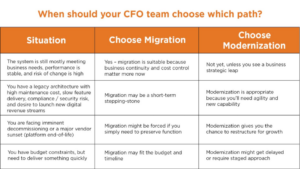
Tip for CFOs: View migration not simply as a cost centre, but as part of a multi-stage modernization roadmap. Many organisations perform an initial migration to stabilize, then follow with modernization phases.
How Flynaut Supports Technical Debt Modernization and Digital Transformation
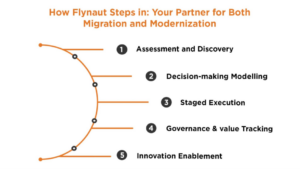
As a custom software development company and digital transformation agency in the U.S., Flynaut supports CFOs across the full modernization lifecycle.
To execute either path effectively, you’ll need a partner that brings: domain expertise in app development, deep experience with legacy systems, modern architectures (mobile, web, cloud-native, microservices), and business acumen across the digital product lifecycle. That’s where Flynaut can deliver:
- Assessment & discovery: We partner with your CFO/CTO teams to perform a technology audit, identify your debt hotspots, measure maintenance cost, identify business value leakage, and map dependency chains, and align initiatives with CFO technology strategy.
- Decision-making modelling: Use the audit data to build a cost/benefit model: what is the total cost of ownership (TCO) of current legacy systems, what is the cost, timeline and benefit of migration vs modernization?
- Staged execution: Whether you choose migration or modernization, Flynaut delivers phased roll-outs: stabilize operations, migrate core, refactor modules, spin new digital services.
- Governance & value tracking: We help set KPIs for debt reduction (e.g., number of legacy modules decommissioned, maintenance cost reduction, defect rate drop), so you can report upward in CFO/CEO metrics.
- Innovation enablement: Post-modernization, Flynaut enables you to build new mobile/web apps, integrate AI/ML, adopt microservices, and deliver enterprise app development services that unlock new revenue lines.
CFO Metrics That Define Successful Technical Debt Modernization
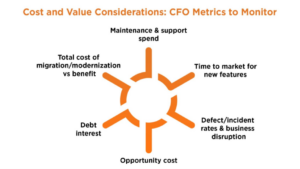
Here are key metrics CFOs should monitor when managing tech-debt and modernisation projects:
- Maintenance & support spend: What fraction of your IT budget is spent on “keeping the lights on”? Some studies show up to 70-80% in legacy environments.
- Time to market for new features: Legacy systems often slow down feature delivery, delaying new revenue or cost-saving initiatives.
- Defect/incident rates and business disruption: High technical debt often correlates with more outages, security incidents, compliance risk.
- Opportunity cost: What new revenue streams or cost-reduction opportunities are you missing because your headcount is stuck in maintenance?
- Debt interest: Think of technical debt like financial debt, you pay interest in extra work, slower delivery, risk. The goal is to reduce interest, not necessarily eliminate all debt.
- Total cost of migration/modernization vs benefits: Build financial ROI models: savings from lower maintenance + faster innovation, cost of transformation.
These metrics collectively define the financial case for technical debt modernization.
A CFO Playbook for Legacy System Modernization and IT Modernization Strategy
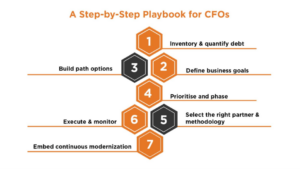
Here’s a practical playbook you can follow, in collaboration with your CIO/CTO and a partner like Flynaut.
1. Inventory & quantify debt
a. Map all applications, infrastructure, data systems.
b. Score each for risk, maintenance cost, strategic value, agility gap.
c. Tag them: “business-critical but debt-heavy”, “low value, high maintenance”, “strategic for next-gen”.
d. Use frameworks like those from AWS and other thought-leaders.
2. Define business goals
a. What are your 12-24 month business priorities? (e.g., new digital channel, M&A readiness, cost reduction)
b. Which systems support those priorities? Which are blockers?
c. Seek alignment between CFO, CEO and technology owners.
3. Build path options
a. Option A: Migration first (quick win) → modernization later.
b. Option B: Direct modernization (bigger upfront but higher long-term value).
c. Model cost, timeline, risk, expected value for each. Use decision-models.
4. Prioritise and phase
a. Prioritise applications with: high maintenance cost + strategic value + risk exposure.
b. Create a phased roadmap: e.g., Year 1 migrate critical modules; Year 2 modernise architecture; Year 3 roll out new digital product.
c. Ensure governance and executive sponsorship.
5. Select the right partner & methodology
a. Choose a partner like Flynaut that can support cloud infrastructure services USA, modernization expertise, and enterprise transformation consulting capability.
b. Use agile, iterative delivery rather than “big-bang rewrite” which often fails.
c. Embed metrics from day one and ensure you have dashboards for CFO/CTO.
6. Execute & monitor
a. Kick off pilot or initial phase.
b. Track KPIs: maintenance cost drop, cycle time to deploy, defect rate reduction, modules decommissioned.
c. Adjust roadmap based on outcomes; ensure real business outcomes (not just delivered code).
7. Embed continuous modernization
a. Modernization isn’t a one-time project, it’s an ongoing journey.
b. Include governance to prevent new technical debt, adopt DevOps/CI-CD, shift-left testing, code quality standards.
c. Align technology strategy with business strategy continually.
Common Technical Debt Modernization Mistakes CFOs Must Avoid
- Big-bang rewrite that fails to deliver, causes disruption and cost overruns. Instead: adopt incremental, modular modernization.
- Viewing migration as end-state rather than intermediate step. Ensure roadmap includes modernization phases.
- Ignoring culture and process, tool/architecture change alone won’t fix the root causes of debt.
- Lack of metrics and transparency, without CFO-level dashboards, you’ll struggle to justify investment.
- Neglecting continuous debt prevention, new code can introduce new debt if quality processes are poor.
Why CFOs Choose Flynaut as a Custom Software Development Company
To achieve number-one status, firms not only need technical excellence but business alignment, domain expertise, future readiness and strong delivery track record. Flynaut brings:
- U.S.-based leadership and global delivery capabilities, aligning with U.S. market needs and time zones.
- Deep experience in mobile and web application development, cloud-native architectures, microservices, API-first design, UI/UX, and maintenance-to-modern pipelines.
- A proven methodology for debt-assessment, roadmap creation, phased migration/modernization, and delivering business outcome metrics.
- Dedicated governance, dashboards and executive-level engagement to ensure CFOs have visibility into value creation, not just code delivery.
- A partnership mindset: treating technology as a business enabler for growth, not just a cost centre.
By positioning Flynaut as your strategic partner for both migration and modernization, you drive down tech-debt, accelerate innovation, reduce risk, and unlock the agility to compete in the digital era, all while providing measurable ROI that matters to the CFO.
Turning Technical Debt Modernization into Long-Term Business Value
For CFOs in growth-oriented companies, the decision between migrate or modernize is not just technical, it’s strategic. When approached correctly, technical debt modernization becomes a catalyst for agility, innovation, and financial resilience rather than a drag on the balance sheet.
By following a structured playbook, quantify debt, align business goals, build options, prioritize phasing, execute with the right partner, monitor metrics and embed continuous modernization, you can turn tech-debt from a drag into a springboard for growth.
Flynaut stands ready to be your partner in this journey: enabling migration when needed, delivering modernization when critical, and delivering measurable value that resonates in the boardroom.
Transform your tech debt into business value.
Partner with Flynaut, the leading app development company in the U.S., to modernize, migrate, and future-proof your digital ecosystem.